
I’ve been covering this business long enough to remember when everybody chased the whales. Big states, big populations, big splashy launches. So when I tell you that one of the more interesting stories in US online poker right now is a company deliberately planting its flag in the smallest markets on the map, I know how that sounds. Bear with me, because the BetRivers small state online poker strategy is smarter than it looks.
Here’s the short version, per reporting from PokerFuse: BetRivers has built an online poker network across some of the tiniest regulated states in the country. Places like Delaware and West Virginia, where it’s described as the only consistent operator presence. Nobody else keeps showing up. BetRivers does.
Why Would Anyone Fight Over Delaware?
This is the question I keep getting from readers. Why plant a flag in states where the entire population wouldn’t fill a decent-sized city?
Because nobody else is there. When you’re the only consistent operator in a market, you don’t have to win a rake war or bleed cash into overlay-soaked tournament series to buy market share. You already have it. There’s no rival across the table undercutting you on promos. The math on a market where you’re effectively alone can look a lot healthier than the math on a big one where several operators are knife-fighting for the same grinders.
We’ve written before about how BetRivers has become something of a fixture in regional US markets, and this is the logical extension of that. Instead of trying to out-muscle the giants in the loud rooms, they set up in the quiet ones and stayed. Consistency turns out to be a real advantage when your rivals treat a market as too small to bother with.
The Part That Actually Matters: Shared Liquidity
Here’s where the small-state thing stops being a novelty and starts being a plan.
A state like Delaware on its own can’t support much of a poker economy. The player pool is too thin. You can’t fill a lobby of games when there aren’t enough players to fill the tables. That’s the fundamental problem with America’s state-by-state poker map, and it’s why so many small markets have historically been dead on arrival.
The fix is shared liquidity, the industry’s clunky term for connecting players across state lines into one combined pool. Add the states together and the tables fill up. According to PokerFuse, BetRivers is now the second operator in the US, after WSOP, to link players across four states into a single shared liquidity pool.
Second ever. For years, WSOP was the only company stitching states together. Now there are two. That’s not a footnote; it’s a shift in how a regional operator can approach this fragmented market.
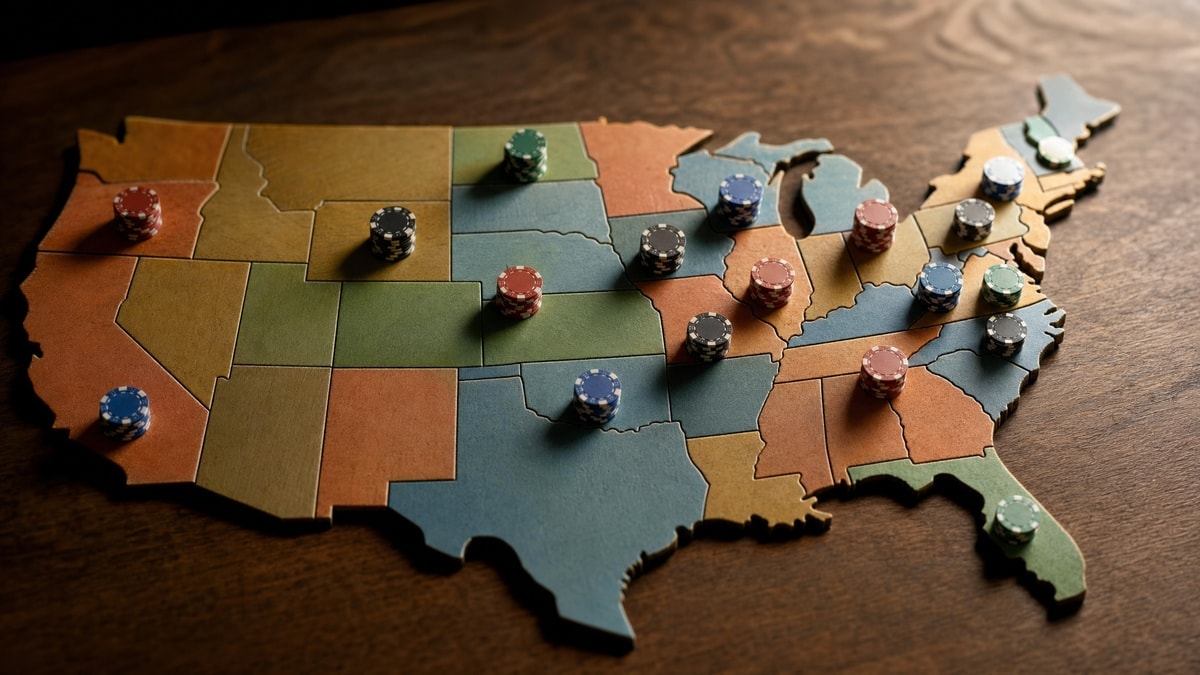
What shared liquidity does for a small-state strategy is turn a bunch of individually unviable markets into one viable network. Delaware alone is a rounding error. Delaware plus a few connected states is a poker room. The states stay legally separate, players stay in their own jurisdictions, but the games get pooled. It’s the difference between four empty diners and one busy one.
New Jersey and the Maine Curveball
So where does it go from here? Two names keep coming up.
New Jersey is cited as a possible next addition to BetRivers’ shared liquidity pool. Nothing’s dated or confirmed, so I won’t pretend otherwise, but the logic writes itself. New Jersey has real infrastructure, a mature online poker market, and a much larger player base than the tiny states BetRivers has been cultivating. Bolt that onto an existing network and you’ve got something with more weight behind it. (For the record, we don’t yet know which four states are currently connected.)
Then there’s Maine. BetRivers has publicly stated interest in launching there, a state of roughly 1.4 million people. That’s the entire pitch on paper: barely more than a million residents, tucked into the corner of the country.
But through the shared-liquidity lens, Maine makes sense. It’s not a standalone play, it’s another puzzle piece. Another small market where BetRivers could be first and possibly the only serious operator, another set of players to feed into the pool. Worth noting: Maine has been in the poker conversation lately for other reasons, having killed sweepstakes poker while pushing for iGaming legalization. A state clearing out gray-market operators and eyeing regulated gaming is exactly where a patient operator wants to be early.
So Is This Actually a Growth Model?
Here’s my honest read, flagged as opinion because I don’t have the revenue figures either way.
The appeal of the BetRivers approach isn’t any single small state. It’s the compounding. Each tiny market is close to worthless alone, which is precisely why competitors ignore them. Strung together through shared liquidity, they become a network nobody else is building. WSOP had a long head start on connected states, and BetRivers is the first company to seriously challenge that with a small-state-first philosophy.
Will it work long term? That depends on things we can’t see yet: launch timelines, regulatory movement in Maine, whether New Jersey actually gets folded in. But the strategic instinct is sound. In a country where the big markets are brutally competitive and the small ones are empty, being the operator who shows up everywhere and quietly wires it all together is a genuinely different bet.
BetRivers seems perfectly happy owning the rooms nobody’s watching. If shared liquidity keeps expanding the way PokerFuse’s reporting suggests, that’s going to look less like a quirk and more like foresight. Keep an eye on it, because the future of the fragmented US market might get drawn in states most players couldn’t find on a map.


